04 · Security questionnaire workflow
TrustRespond.ai
A reviewable RAG workflow that turns internal security evidence into structured questionnaire drafts while keeping sources, uncertainty and human approval visible.
Role
Product architecture and AI workflow engineering
Core decision
Draft with AI; release through review
Status
Functional private prototype
The problem
Vendor security questionnaires repeatedly ask teams to map policies, controls and audit evidence into large Excel workbooks. Manual work is slow and inconsistent; unconstrained AI is faster but can invent evidence, hide gaps and destroy the workbook structure that customers expect back.
The architectural decision
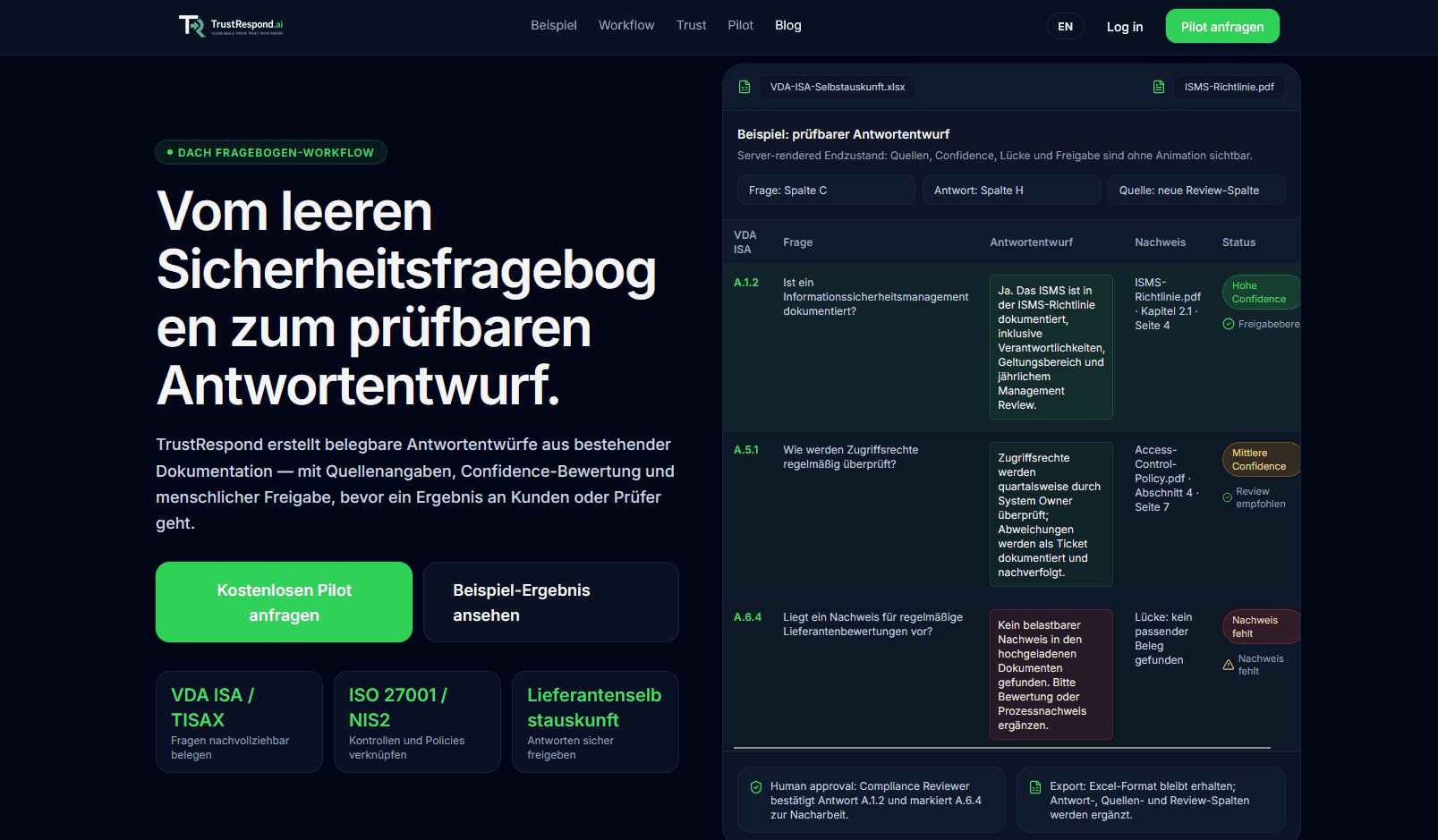
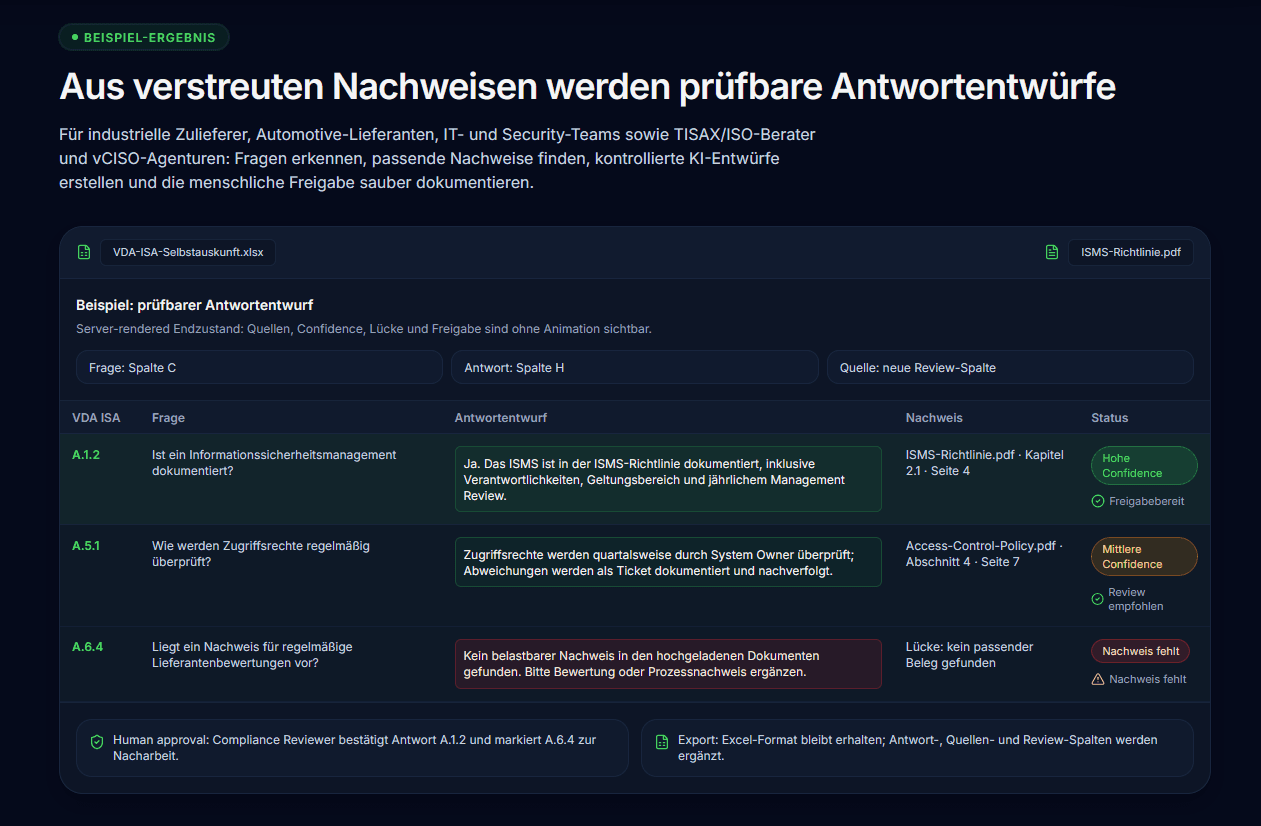
TrustRespond treats generation as a draft stage. Organization-scoped retrieval supplies evidence, structured output maps answers into the questionnaire, confidence and gaps remain visible and a human reviewer decides what may leave the system. The original workbook remains the delivery contract.
From evidence to approved answer
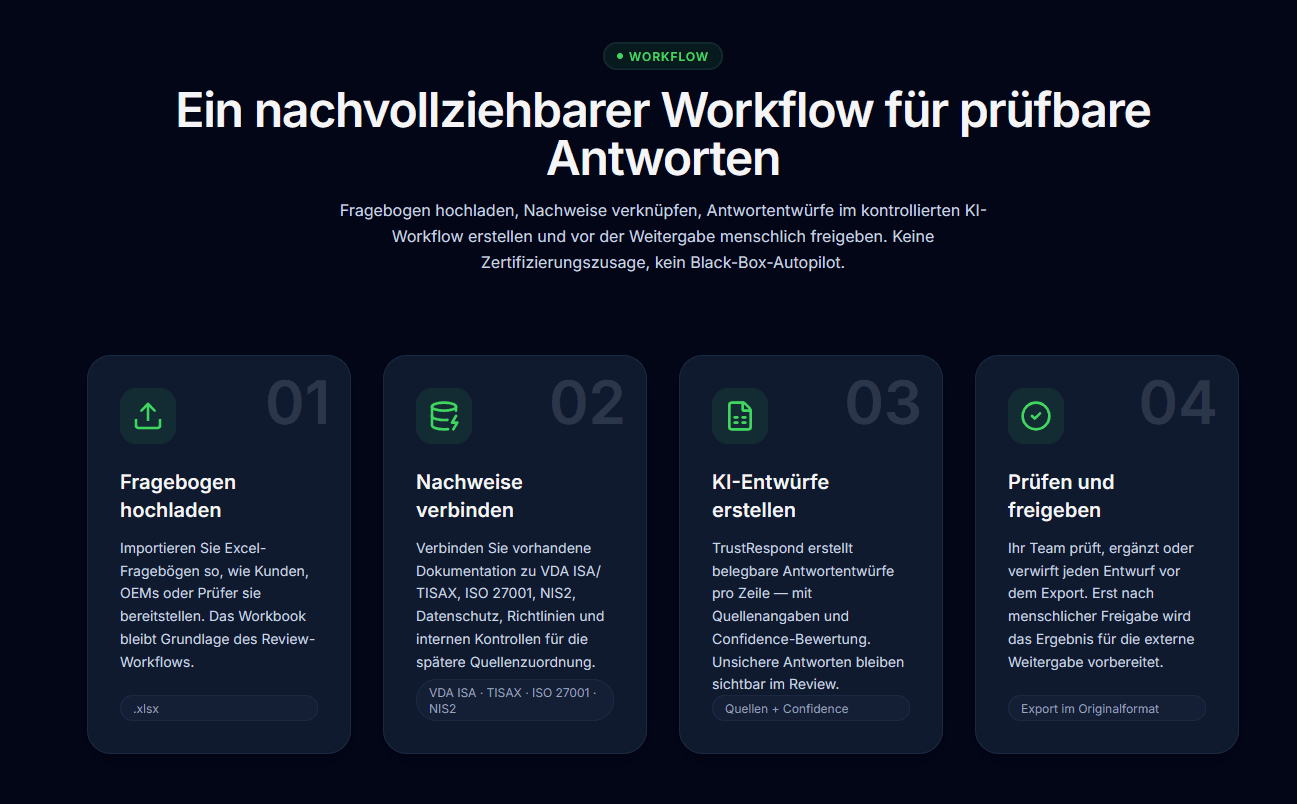
Ingest knowledge
Security policies and supporting documents enter an organization-scoped knowledge base.
Read the workbook
The questionnaire parser preserves the Excel structure and identifies the question and answer mapping.
Draft from sources
Gemini generates structured answers from retrieved evidence with bounded batching and fallback behaviour.
Review and export
A reviewer inspects answers, sources, confidence and missing evidence before producing the XLSX output.
What the repository proves
Execution-ready monorepo
A Next.js web app, background worker, database package, AI package, parsers, shared UI and validated configuration separate product surfaces from long-running work.
Tenant-aware data boundaries
Multi-tenant schema foundations, RLS and organization-scoped job access keep privileged generation paths from crossing customer boundaries.
Reviewable generation
Questionnaire generation uses structured pipeline primitives, bounded concurrency, batching, retry and fallback while preserving review states instead of silently publishing model output.
Secure go-to-market path
The public pilot flow uses server validation, honeypot, rate limiting and Turnstile. Lead records are written before email delivery, and confidential questionnaires are not requested through ordinary email.
Reliability boundaries
AI output remains a draft until a person approves it.
Sources, confidence and missing evidence are first-class review signals.
RLS and organization-scoped services protect tenant boundaries around jobs and storage.
No speed, accuracy or customer-adoption metric is claimed without a reproducible benchmark.
Current implementation boundary
TrustRespond is a functional private prototype and technical foundation, not a certification authority or a claimed enterprise deployment. The repository verifies the upload, retrieval, generation, review and XLSX-export architecture; production outcomes still require customer-specific evaluation.
Why it belongs in the top four
TrustRespond translates RAG into a business workflow that buyers immediately understand. More importantly, it demonstrates responsible automation: the system accelerates evidence mapping without hiding uncertainty or removing the reviewer who owns the final answer.